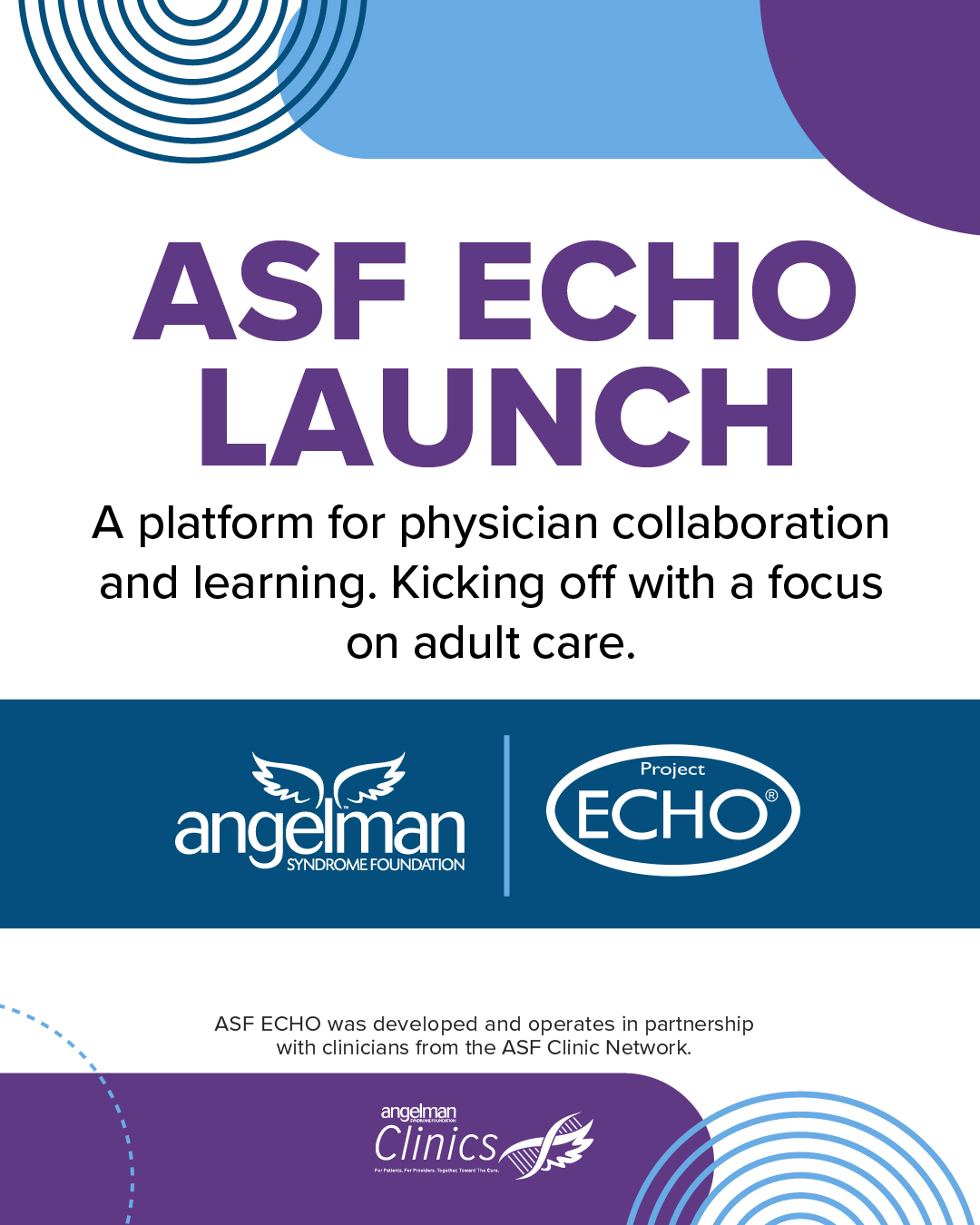
The Angelman Syndrome Foundation (ASF) is proud to announce the launch of its first-ever ASF ECHO (Extension for Community Healthcare Outcomes) Program, a groundbreaking initiative designed to connect clinicians with leading experts in Angelman syndrome (AS) and expand access to high-quality, informed care.
Built on the globally recognized Project ECHO model and developed with guidance from leading partners at ECHO Autism and the Rare Epilepsy Network (REN), ASF ECHO is a virtual, case-based learning program that brings healthcare providers from across disciplines together to collaborate, share expertise, and improve outcomes for individuals living with Angelman syndrome.
This initiative represents a natural extension of the ASF’s growing Angelman Syndrome Clinical Network, a coordinated system of specialized clinics and specialty providers working together to increase access to expert care, standardize best practices, and ensure families can receive knowledgeable Angelman support closer to home. Through ECHO, the ASF hopes to expand access to AS expertise beyond clinic walls by extending an open invitation to all providers seeking to learn, collaborate, and strengthen AS care across the lifespan in their own communities.
Addressing a Critical Gap in Adult Care
The inaugural ECHO series, “Caring for Adults with Angelman Syndrome,” reflects a pivotal moment for the community. As individuals with AS are living longer, healthier lives, the need for clinicians equipped to support adults with complex neurogenetic conditions has never been greater.
“Families have long shared the challenges of navigating adult care for Angelman syndrome,” said Amanda Moore, CEO of the Angelman Syndrome Foundation. “With ASF ECHO, we are not only expanding education, we are building a connected system of care that ensures individuals with AS are supported at every stage of life.”
“Knowledge about caring for adults with Angelman syndrome and other rare neurogenetic conditions is often siloed and difficult to access. By connecting experts with community providers and using case-based learning, this ASF ECHO series aims to share that expertise more broadly with the goal of improving the quality of care and ultimately the quality of life for adults with AS and their caregivers.” Stated by Dr. Lindsey Wilfreda, the Clinic Lead at the Kennedy Kreuger Angelman Syndrome Clinic.
Leading Experts and Collaborative Voice
The inaugural series will be facilitated by Dr. Wilfreda Lindsey, Developmental Neurologist, Director of the Angelman Syndrome Clinic at Kennedy Krieger Institute, and a recognized leader within the ASF Clinical Network. The series will feature both didactic and case discussions from other well-known subject matter experts in the ASF Clinical Network.
The first session will also feature Niki Armstrong, MS, CGC, Vice President of Genetic Services and Education from the Foundation for Angelman Syndrome Therapeutics (FAST), who will be bringing an important perspective to the discussion and collaborating on future programming. Her involvement underscores the joint effort across organizations to ensure that clinical education is informed not only by medical expertise, but also by the lived experiences of individuals with Angelman syndrome and their families.
Together, faculty and guest speakers will lead sessions that combine expert insight with real-world application. The series will begin on May 11, 2026 and cover the following critical topics:
- Life as an Adult with Angelman Syndrome
- Transitioning from Pediatric to Adult Healthcare
- Complex Medical Concerns in Adult Patients
- Neurodevelopmental, Psychiatric, and Behavioral Health Considerations
A Collaborative Model for Lasting Impact
The ASF ECHO Program is designed for a wide range of healthcare providers including clinical providers, therapists, and allied health professionals who support individuals with Angelman syndrome The ASF enthusiastically welcomes the participation of individuals outside of the of the ASF Clinical Network. By fostering collaboration and shared learning through the ECHO model, our program aims to help bridge the gap between specialized expertise and everyday clinical practice and advance the ASF’s commitment to:
- Expand access to knowledgeable AS providers
- Supporting the implementation of emerging AS Standards of Care
- Reduce disparities in care across geographic regions
- Improve long-term health outcomes and quality of life for individuals with AS
“Our goal is to establish an educational resource that helps breaks down traditional barriers to clinical expertise.” says Shari Welch, ASF Director of Clinical Programs “Collaborating with our network has shown me firsthand how life-changing the right connection to care can be. The ASF ECHO program aims to extend the impact of these incredible AS clinicians beyond the walls of our clinics—empowering providers everywhere to build the skills and confidence they need to become the next generation of AS experts.”
Join the Movement to Improve Care
Clinicians interested in participating in the ASF ECHO series can can join the interest list to receive registration details.
ASF invites healthcare professionals across disciplines to take part in this important effort to strengthen care, build connections, and improve outcomes for individuals with Angelman syndrome.
###
About the Angelman Syndrome Foundation
The Angelman Syndrome Foundation is dedicated to supporting individuals with Angelman syndrome and their families through research, education, and advocacy. ASF is leading efforts to build a coordinated clinical network, advance Standards of Care, and ensure access to lifelong, comprehensive care for all individuals with AS.
About the ASF Clinical Network
The goals of the ASF Clinical Network are:
- Connecting families with experienced, highly specialized medical providers. Providers within the clinics have experience and expertise in treating the rare disorder, which has historically been difficult for families to find.
- Connecting medical providers with one another, through quarterly video calls to share information about their most challenging cases.
- Connecting the pharma industry with much needed locations to host clinical trials, with the benefits of having patients in place when they become available.
- Maintaining the LADDER Database, its global network of patient data, to ease the burden of paperwork on families.
Make this larger to draw attention because there is a lot of reading above it. Might even want to put a QR code or link at the top as well because a lot of physicians won’t read this long.