Funding High-Caliber
research for AS

ASF has invested more than $15.7 million in Angelman syndrome research to date, supporting projects worldwide in the quest to find treatments and ultimately a cure. Research is the key to unlocking discoveries that will lead to safe, effective therapies and a significantly better quality of life for every individual living with Angelman syndrome.

Angelman Syndrome Foundation

Research Highlights

Research Investment Since 1996
$ 0 M*
Approved for funding in FY2023 & Beyond**
$ 0 K
ASF Clinics Exist Worldwide
0
Provided Directly to Families in 2023
$ 0 K+
*Cumulative research investment: $15,773,906.
**Total includes first- and second-year grants from current and/or prior year funding rounds. Full award amount is not fully expensed during a fiscal year if the study is multi-years.
Our Philosophy

ASF Focuses Heavily on Pilot Funding

We use a small amount of money to test drive an idea. If the test drive looks good, the researcher is then able to ask larger agencies, like the National Institutes of Health, Simons Foundation and other pharmaceutical companies to provide more funding to expand the project. Every pivotal idea started with pilot funding.

ASF Focuses On Three Types of Research

To use a sports analogy, not every study has to be a home run to make an impact. Four base hits also leads to a run scored.

High-Risk, High-Reward
1

Strategies to find a cure, including topoisomerase inhibitors, ASOs, gene therapy and CRISPR

Clinical Studies
2

To alleviate symptoms and improve quality of life

UBE3A Studies
3

To help us learn about UBE3A and what it does in the brain

Hear From Our Researchers

Dr. Art Beaudet

Dr. Charlie Williams

Impact of ASF Funded Research

+$15.7 million in research funding from ASF has helped drive +$200 million in additional contributions.

ASF funded the first ASO studies proving that the therapeutic approach would work. ASF has also funded new, innovative ideas still in the development stage but strong enough to be supported by pharmaceutical companies.

ASF Funded Research

ASF is committed to advancing the most innovative and impactful research focused on Angelman syndrome. Through our investment in groundbreaking studies, the ASF is driving progress that not only improves lives today but paves the way for transformative treatments tomorrow.

Find a Research Project

Year
Research Year
Category
Research
Researcher
Researcher

Filter by Event Type

Event Type

Filter by Event Type

Event Type

Research

2023
Emily Farrow, PhD, CGC
UMKC School of Medicine
Development and Implementation of a Novel Comprehensive Panel for the Early Detection of Angelman Syndrome
Age of Treatment
Early Diagnosis
Newborn Screening

A classic phenotype of AS has been described which includes developmental delay, intellectual disability, speech impairment, gait ataxia and a happy demeanor. However, these features are not apparent in infancy. Further, initial symptoms of developmental delay are non-specific, which often complicate a diagnosis. The underlying molecular mechanism of AS is complex, and is known to be caused by methylation defects, deletions, and pathogenic single nucleotide variants in UBE3A, currently requiring multiple clinical tests to access. Taken together, despite the prevalence of AS, many patients do not receive a timely molecular diagnosis, may receive an incorrect diagnosis, or receive no diagnosis at all.

As precision therapeutics are increasingly developed, including ASOs which have shown tremendous promise in animal models, receiving a molecular diagnosis becomes exponentially more important. This project will address the current limitations of diagnostic testing for AS by utilizing a novel long read (LR) based sequencing approach, capturing multiple disease categories and variant types in a single economical test.

More
2023
Anne Wheeler, PhD
RTI International
Development and Validation of an Angelman Specific Behavior Measure
Behavior

Individuals with Angelman syndrome (AS) are known to have an increased likelihood of exhibiting challenging behavior, especially in situations that are anxiety provoking. These behaviors substantially affect family functioning and caregiver mental health. However, there is not a well-established and validated measurement that helps capture the frequency, nature, and severity of challenging behavior in people with intellectual disability, much less in conditions like AS, where communication challenges are a significant problem.

The FDA developed a series of four methodological patient-focused drug development (PFDD) guidance documents which highlights the importance of using patient input to identify endpoints that are important and valid. As several potential future therapies for AS are being developed, an assessment that appropriately and objectively measures behavioral symptoms is needed.

More
2022
Eric Levine, PhD
University of Connecticut
Contribution of hemizygous HERC2 deletion to Angelman syndrome pathophysiology
Antisense oligonucleotides
Crispr/Cas9
HERC2
Stem Cells
UBE3A
UBE3A Mutations

$200,000
2 years

Individuals with a deletion of chromosome 15q11-q13 suffer from Angelman syndrome (AS), a neurogenetic developmental disorder characterized by intellectual disability, motor ataxia, absent speech, and seizures. The specific gene that is responsible for AS encodes the ubiquitin protein ligase UBE3A, although other genes in the region are also deleted.

AS can also result from loss of function mutations of UBE3A, which spares the other genes located in the region. UBE3A mutation AS patients typically have a less severe phenotype, especially with regard to cognitive and motor dysfunction and the incidence of epilepsy. This suggests that the loss of other genes in the region, in addition to UBE3A, likely contribute to the more severe phenotype in deletion AS patients. In particular, the HERC2 gene, which also encodes an E3 ubiquitin ligase, is located within the region typically deleted in AS.

Loss-of function mutation of HERC2 itself causes a severe neurodevelopmental phenotype with Angelman syndrome-like features. We hypothesize that the hemizygous loss of HERC2 contributes to the more severe behavioral phenotype in deletion AS individuals, and in conjunction with loss of UBE3A, will result in increased severity of cellular phenotypes in human AS stem cell-derived neurons.

We will test this hypothesis by comparing electrophysiological and morphological phenotypes of AS neurons derived from mutation and deletion AS patients. We will use antisense oligonucleotide and CRISPR-editing approaches to determine if reducing HERC2 expression in UBE3A-deficient neurons will confer the increased excitability, altered synaptic transmission, and other cellular phenotypes seen in neurons derived from AS deletion individuals. These studies will shed light on the cellular mechanisms responsible for behavioral phenotypes in AS and identify molecular targets for development of novel therapeutics.

Summary & Update

In neurotypical individuals, the UBE3A gene on chromosome 15 allows the proper breakdown of proteins in the brain. In Angelman Syndrome (AS) the breakdown of these proteins is impaired because the UBE3A gene is either deleted completely or it’s mutated to a nonfunctional form. This can mean that the mutated gene variants can cause either less of the functional UBE3A or a completely nonfunctional version of the UBE3A.

Furthermore, the cells that are affected, are usually neurons, the cells in our brains! These cells have a standard way of sending signals, using ions (sodium, potassium, calcium) that give the cell a net positive or net negative cell compared to its environment. These processes, termed depolarization and repolarization, help cells send those signals. When there is enough of a negative charge (from depolarization) the cell reaches what is called a “threshold” that acts like permission for that neuron to speak to the next neuron. The messages spread and spread. We measure this through electrophysiology and can describe it as a cell’s biochemical characterization.

Another gene of interest is HERC2. This gene is typically not affected in individuals with mutation-AS. However, because deletions occur randomly, not every deletion is at the same starting and ending point. Sometimes, this means HERC2 (among other genes) can get cut out in addition to UBE3A. Much like UBE3A,HERC2 encodes a protein that tags the neuron proteins for breakdown.

GABA-A receptors, which may be implicated in altering neuron communication in AS, typically functions by inhibiting communication between neurons.
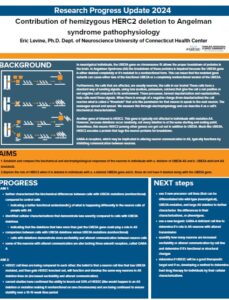

See more information

More
2022
Ype Elgersma, PhD
Erasmus Medical Center
Individuals with ICD/UPD Mutations Participating in ASO Trials
Antisense oligonucleotides
ICD
UBE3A
UBE3A Mutations
UPD

$99,000
2 years

Angelman syndrome (AS) is caused by loss of maternal UBE3A expression. In neurons, paternal UBE3A is silenced by the UBE3A-ATS transcript, resulting in a total loss of UBE3A in AS neurons. Promising preclinical data by the Beaudet and Elgersma labs showed that ASO therapy is effective in activating the paternal Ube3a gene which results in an improvement of several phenotypes of Ube3a mice.

Phase I clinical trials are currently evaluating ASO safety in individuals with AS.  However, these trials do not enroll AS patients carrying imprinting center defects (ICD) or uniparental disomy (UPD) mutations because there is a potential risk for negative effects of UBE3A overexpression in these patients.  Although recent studies indicate that 2-fold UBE3A overexpression in mice does not induce deleterious effects, we do not know the consequences of UBE3A overexpression in the ICD/UPD genomic context in which the MKRN3, MAGEL2, NDN, SNRPN proteins as well as overexpression of the SNORD115, 116 gene cluster are overexpressed. Notably, recent studies suggest that there is a synergy between UBE3A overexpression with overexpression of other genes in the 15q-11 locus as observed in individuals with Dup15q syndrome. Hence it is important to be careful.

The Resnick lab has recently generated an ICD/UPD mouse model for AS, and we found that these mice robustly recapitulate all the phenotypes that we previously identified in Uba3a mice (unpublished data). In addition, together with the Philpot lab, we have recently generated and characterized a transgenic mouse line which overexpresses UBE3A (Ube3a+2 OE mice). Hence, we can now combine these models to address the concern if 2-fold overexpression of UBE3A in the ICD/UPD background would result in a full behavioral rescue, or in an incomplete rescue or possible even in deleterious phenotype.

Although our working hypothesis is that the ICD/UPD x Ube3a+2 mice will show a full rescue, we believe that demonstrating this in mice, is critical to move forward with ASO therapy in AS individuals with ICD and UPD mutations.

Why this study is important

ASOs are exciting therapeutics because they replace the very gene product missing in individuals with AS. However, we don’t really understand how well they work when administered at different times during development, and we also don’t know how well they work in individuals with AS due to different causes (i.e. UPD or deletions). Even with two papers published in this area using UBE3A mutation mice, different ASOs may have different effects, and restoring UBE3A from both copies in mice with UPD and/or large deletion may have different results.

More
2022
Ryan Butler, PhD
UT Southwestern
shRNA-mediated gene therapy for the treatment of Angelman Syndrome
Gene Therapy
shRNA
UBE3A

$200,000
2 years

Angelman syndrome occurs because of a missing or malfunctioning gene called UBE3A on the maternal chromosome. Normally, UBE3A gene expression occurs only on the maternal chromosome while the paternal chromosome is silenced.

The approach in this study builds on several recent preclinical and clinical studies which demonstrated that it is possible to activate the paternal allele by inhibiting the UBE3A antisense silencer UBE3A-ATS. This approach is commonly referred to as “stop-the-stop.” In addition, this approach utilizes adeno-associated viral vector type 9 (AAV9) gene therapy which confers widespread distribution across the central nervous system.

If effective, this could yield permanent paternal UBE3A gene expression with a one-time dosing regimen. Therefore, the experiments proposed here could represent a vast improvement over existing therapeutic intervention.


RESULTS

Promising results from this study were published in 2026.

More